
Stress and Resilience
Stress Symptoms - The Body Tells the Story
- Irritability
- “Short-fuse”
- Difficulty Relaxing
- Sleep Disruption
- Distractibility
- Short-term Memory Loss
- Stomach Pain
- Stomach Fat
- Burning Feet or Tongue
- Extreme Fatigue
- Chest Pains
- Visual Errors
- Noise Intolerance
- Derealization
- Depersonalization
Key Concepts to Proactively Manage Stress and Build Resilience:
Protecting the Goose | Building Buffer | Creating a Multi-faceted Identity
Protecting the Goose
The Goose Who Laid Golden Eggs
There was once a Countryman who possessed the most wonderful Goose you can imagine, for every day when he visited the nest, the Goose had laid a beautiful, glittering, golden egg.
The Countryman took the eggs to market and soon began to get rich. But it was not long before he grew impatient with the Goose because she gave him only a single golden egg a day. He was not getting rich fast enough.
Then one day, after he had finished counting his money, the idea came to him that he could get all the golden eggs at once by killing the Goose and cutting it open. But when the deed was done, not a single golden egg did he find, and his precious Goose was dead.
Application to Peak Performance
In Stephen Covey’s, “The 7 Habits of Highly Effective People,” Mr. Covey suggests that we are the asset, the goose, and so we have production capability. Our production is the golden eggs.
The number one mistake I see in my high achieving clients is the lack of seeing and treating themselves as an asset. In financial terms, an asset produces money. The health of the asset becomes a number one priority for anyone who wants to reap financial gain over the long-term. Short-term focus can destroy the viability of an asset. If you spend the $1 that was supposed to grow $100, you have just killed the goose.
High achievers have a great capacity to produce wonderful personal and financial outcomes. They may be excellent at developing their colleagues, encouraging their families, implementing lucrative business strategies, or bringing high value to their companies. Yet, they do not see themselves as the goose.
When you do not see yourself as the goose (asset), you tend to take your production capacity for granted. You may function by “burning the candle at both ends” for years without seeing a noticeable shift in your production capability. Like the farmer, you assume that somehow the goose will continue to produce golden eggs.
Like the goose, we are bound by physical laws of nature. Specifically, our production is limited by our physical health, our energy, and our emotional stability. I have repeatedly watched people ignore the finite boundaries of all of these categories and expect the goose will somehow keep producing. It is an area of concern for high achieving personalities who have difficulty giving themselves the breaks and the balance their body needs.
When people ignore the boundaries of energy, they compromise the asset both physically and emotionally. Physically, the cost to the asset includes a compromised musculoskeletal strength and decreased cardiovascular fitness. Exacerbated body pains (i.e. backaches) and chronic pain conditions (i.e. fibromyalgia) decreases the quality and quantity of performance. Emotionally, the cost to the asset includes increased anxiety symptoms (headaches, digestive issues or sleep disruption) and low grade depression, which reduces motivation and energy. High stress can lead to all of the above symptoms as well as compromised adrenals and increased cortisol levels (which increases stomach fat). The breakdown to the goose is gradual, and thus often ignored until the symptoms are bad.
Like other areas of peak performance, delayed gratification is necessary. Practice sacrificing the short-term comfort of “plowing through” for the long term payoff of continued optimal functioning.
Regrettably, just like the goose, you are a mortal being. There is an endpoint at which you can no longer produce golden eggs. However, if you work to nourish the goose, you optimize your capacity to produce over the long term.
Application to Peak Performance
In Stephen Covey’s, “The 7 Habits of Highly Effective People,” Mr. Covey suggests that we are the asset, the goose, and so we have production capability. Our production is the golden eggs.
The number one mistake I see in my high achieving clients is the lack of seeing and treating themselves as an asset. In financial terms, an asset produces money. The health of the asset becomes a number one priority for anyone who wants to reap financial gain over the long-term. Short-term focus can destroy the viability of an asset. If you spend the $1 that was supposed to grow $100, you have just killed the goose.
High achievers have a great capacity to produce wonderful personal and financial outcomes. They may be excellent at developing their colleagues, encouraging their families, implementing lucrative business strategies, or bringing high value to their companies. Yet, they do not see themselves as the goose.
When you do not see yourself as the goose (asset), you tend to take your production capacity for granted. You may function by “burning the candle at both ends” for years without seeing a noticeable shift in your production capability. Like the farmer, you assume that somehow the goose will continue to produce golden eggs.
Like the goose, we are bound by physical laws of nature. Specifically, our production is limited by our physical health, our energy, and our emotional stability. I have repeatedly watched people ignore the finite boundaries of all of these categories and expect the goose will somehow keep producing. It is an area of concern for high achieving personalities who have difficulty giving themselves the breaks and the balance their body needs.
When people ignore the boundaries of energy, they compromise the asset both physically and emotionally. Physically, the cost to the asset includes a compromised musculoskeletal strength and decreased cardiovascular fitness. Exacerbated body pains (i.e. backaches) and chronic pain conditions (i.e. fibromyalgia) decreases the quality and quantity of performance. Emotionally, the cost to the asset includes increased anxiety symptoms (headaches, digestive issues or sleep disruption) and low grade depression, which reduces motivation and energy. High stress can lead to all of the above symptoms as well as compromised adrenals and increased cortisol levels (which increases stomach fat). The breakdown to the goose is gradual, and thus often ignored until the symptoms are bad.
Like other areas of peak performance, delayed gratification is necessary. Practice sacrificing the short-term comfort of “plowing through” for the long term payoff of continued optimal functioning.
Regrettably, just like the goose, you are a mortal being. There is an endpoint at which you can no longer produce golden eggs. However, if you work to nourish the goose, you optimize your capacity to produce over the long term.
Buffer
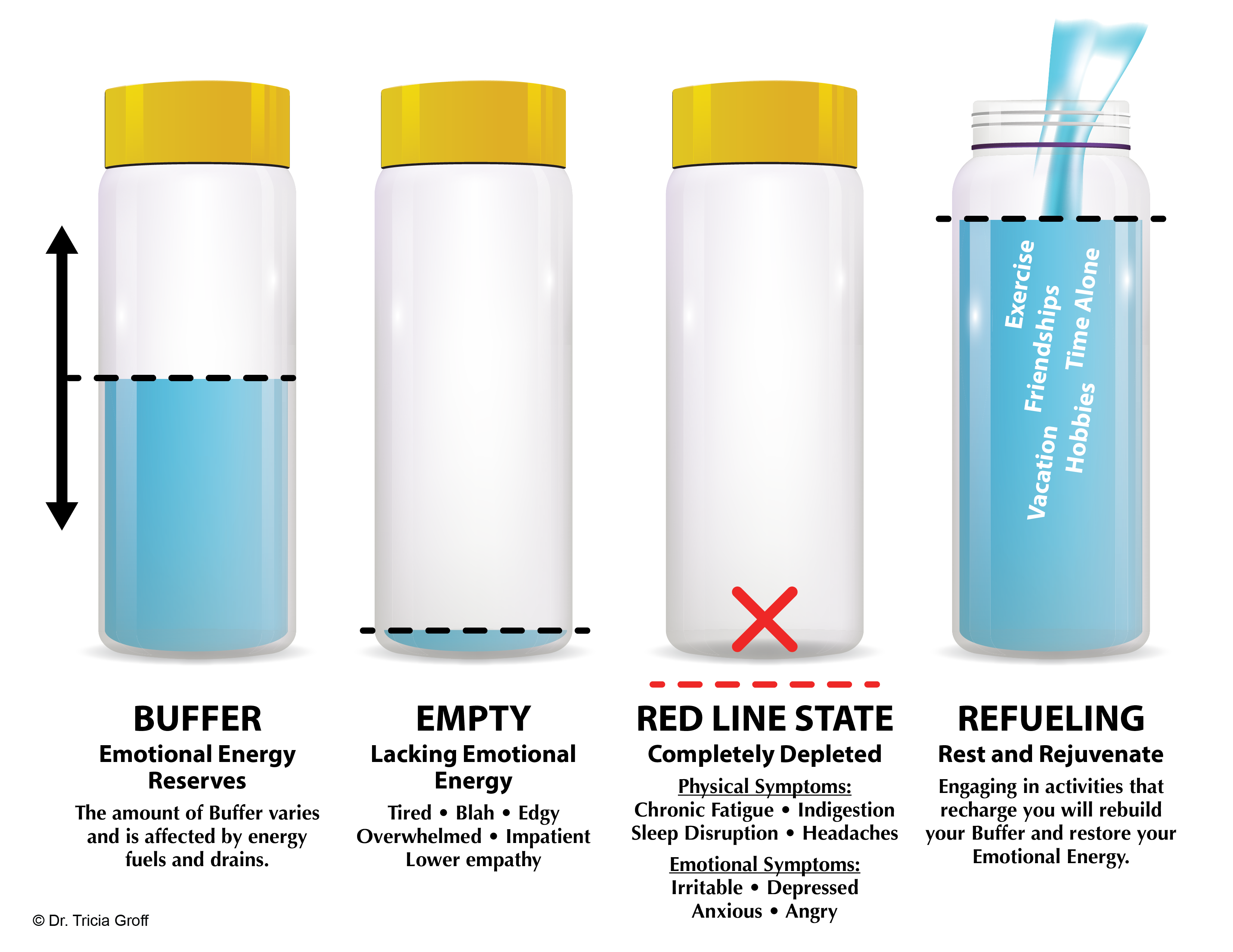
High achievers frequently assume that energy is limitless and that they can continue to max themselves out without consequences. “I’ll catch up on rest later.” This assumption can be reinforced by years of using one’s intellectual prowess to make everything work out. What is unseen is the accumulated physical toll of this strategy. The common physical symptoms in high achievers include digestive issues, increased stomach fat (resulting from increased cortisol), and muscular aches. High achievers tend to intellectualize emotions, and their bodies pay the price. Because of the tendency toward rationalizing and trying to work through difficulties at a cognitive level, high achievers often under-estimate the degree to which an issue may upset them.
Multi-Faceted Identity for a Strong Table of Resilience
A multi-faced identity occurs when a person’s view of themselves comes from several sources. Imagine a table that is strongly supported by multiple legs instead of only one. A person may have a work identity, a sports identity, a family identity. They perceive themselves and are perceived by others slightly differently as they express these different facets in their daily lives. Rather than creating chaos, these different facets help us feel strong. Yes, sometimes we feel torn in multiple directions; however, if work is going poorly, we can feel good about our family. If everything in the week has gone wrong, we obtain comfort in the fact that we ran an extra mile that morning.
Have you met anyone whose sense of purpose was completely wrapped around only one dimension of life? What happens if a professional ball player has no identity except the game and develops an injury that requires premature retirement? What happens when a businessperson invests her heart and soul ONLY into a business and the business is irretrievably lost through tragedy or litigation? By contrast, if she has several non-work relationships and feels good about her fitness, she know that at least there are two areas of her life that are still intact. This is the difference between super-stressed but still standing…. and SPLAT.
Developing and maintaining multiple legs of our table is a proactive skill so that we can maintain optimal wellness and performance in times of crises. Because it is proactive, rather than reactive, understand that many other things will seem to take priority. There are many tasks that are easier and afford more instant gratification than trying to build new friendships outside of the ready-made petri-dishes of college and work environments. Yet, numerous research studies show that close friendships buffer us against stress and increase longevity. As with many important disciplines, it is difficult to fully realize the full return on our investment until a stressor hits and we think “thank God, I still have _____.”
Developing Your Table Legs
Emotional. Do you feed yourself positive information on a regular basis or is all of your information from the news or work journals? Do you take time to acknowledge that you’ve made an impact, helped a friend, or offered value to others? Are you tuned in to your emotional needs or do you try to shove them aside? Building your emotional intelligence and nourishing a positive perspective will help you to prevent stress and to bounce back after difficulty.
Vocational. Do you obtain a sense of satisfaction and purpose in your career? Do you feel a connection to what you are doing or to your colleagues? If you are just “putting in time” or dealing with Sunday dread on a regular basis, it may be time to explore other options. Vocational stress is the opposite of building resilience. It tends to make people doubt themselves and their place in life.positive perspective will help you to prevent stress and to bounce back after difficulty.
Spiritual. If you are part of an organized religion, spend the time finding the organization that feels really good to you. If you are spiritual but not religious OR just feel not spiritual at all, focus on what gives you meaning in life. Make gratitude lists or journal. The research on spirituality shows that regardless of one’s specific belief, people who have a spiritual connection fare better during times of high stress.
Social. If all of your social relationships are from only one or two settings (i.e. work or church), seek to expand your circle. The research on longevity shows that social relationships increase longevity. Join special interest groups, volunteer organizations or find neighbors with similar interests. Anticipate and plan for time and effort on the front end until you are able to find a cluster of healthy, happy people to form your support system.
Physical. Find something you like to do that keeps you physically active. If you get bored easily, just make a commitment to change things up every several months or pick a few activities and vary your routine each week. Figure out what is helpful motivation. If you dread sweating and getting out of breath, hang in there. Building or re-building a base level of fitness is always the most difficult part. volunteer organizations or find neighbors with similar interests. Anticipate and plan for time and effort on the front end until you are able to find a cluster of healthy, happy people to form your support system.
Play. Is having fun part of your daily life? Do you have the skill of making tedious things fun? If not, develop it. Play is one of those qualities we accept in children and dismiss as important for adults. People generally don’t compliment each other on their success at integrating joy into their daily lives. Play bolsters our immune system and helps us rebound after difficult times.t end until you are able to find a cluster of healthy, happy people to form your support system.